The Myth That Easy Means a Shorter Recipe
When people say they want dinner planning to be easier, the word "easy" almost always gets translated into "faster recipes" or "fewer ingredients." That's a reasonable guess, but it misses where the actual friction lives. A fifteen-ingredient braise that you already planned for on Sunday is easier, in every way that matters, than a five-ingredient stir-fry you're inventing from scratch at six in the evening with no plan and half the ingredients missing.
The friction in a typical week rarely comes from any single recipe being too complicated. It comes from the number of small choices stacked on top of each other: what to make, whether you have what it needs, whether anyone will actually eat it, and when to fit the shopping in. A shorter ingredient list doesn't solve any of that. It just makes one part of the evening slightly quicker, while leaving the harder parts — the choosing and the shopping — exactly where they were.
Real ease comes from reducing the number of times those choices have to be made from a standing start. If Tuesday's dinner was decided last weekend, cooking it on Tuesday isn't a decision anymore; it's just execution. That's a meaningfully different kind of easy than a recipe that merely takes less time at the stove.
It helps to picture two versions of the same Tuesday. In one, dinner was chosen on Sunday, the ingredients were on the shopping list that same day, and by Tuesday evening the only remaining task is to actually cook. In the other, nothing was decided in advance, and by six o'clock someone is standing in front of an open fridge trying to reverse-engineer a meal out of whatever's there. The second Tuesday might still end in a perfectly good dinner, but it took far more effort to get there, even if the meal itself was objectively simpler than the first. Ease lives in the gap between those two evenings, not in the recipe either one happens to use.
The Myth That Easy Means Fewer Calories or a Stricter Diet
There's a second, quieter myth tangled up in "easy dinner planning" — the assumption that simplifying a week's meals must also mean tightening them, cutting them down, or making them more virtuous. Easy and healthy get treated as the same project, when they're really two separate ones. A plan can be genuinely simple to follow and still include a rich pasta on Friday and a heavier stew in the middle of the week.
Conflating the two often backfires. A plan built around strict rules — no repeats, nothing processed, a certain number of vegetables per meal — adds constraints on top of the underlying task, and constraints are exactly what make planning hard in the first place. The person following that plan now has to solve two problems simultaneously: what fits the week, and what fits the rulebook. It's no surprise that plans like this tend to get abandoned by Wednesday.
A calmer version of easy treats health as something that shows up gradually, through the ordinary act of knowing dinner ahead of time rather than reaching for whatever's fastest under pressure. Planning does tend to nudge meals toward more variety and more cooking at home, simply because there's room to think about it in advance instead of reacting in the moment. But that's a side effect of having a plan, not the point of it, and it works better when nobody's trying to force it.
It's worth saying plainly that a plan doesn't need a nutritional theme to be worth keeping. A week that includes a rich baked pasta, a simple soup, and a heavier stew isn't a lapse that needs correcting the following week. Treating every plan as an opportunity to also fix eating habits tends to make the plan itself feel like an obligation rather than a convenience, and that's usually the point where people stop bothering to write one down at all. Separating the two goals — a plan that's easy to follow, and food that's generally reasonable — lets each one succeed on its own terms instead of one quietly sabotaging the other.
The Tradeoff Between a Fixed Plan and a Flexible One
Every approach to dinner planning has to answer one real tradeoff: how rigid should the plan be? A fully fixed plan — the same meal every Monday, no substitutions, decided a month out — is extremely easy to execute because there's nothing left to figure out. But it's fragile. The first week someone's schedule changes, or a recipe turns out to need an ingredient nobody has, the whole structure has to be rebuilt from scratch, which defeats the purpose.
A fully loose plan — a vague sense of "we'll figure it out" — avoids that fragility but reintroduces the original problem: too many decisions, made too late, with too little information. This is the version most people already live with, and it's rarely described as easy by anyone doing it.
The workable middle sits closer to the fixed end than most people expect. A plan for the week, made once, with the explicit understanding that Wednesday can swap places with Thursday if plans change, is both easy to follow and resilient to the ordinary disruptions of a normal week. The plan isn't a contract; it's a default. Defaults are what make things easy, because they remove the need to decide unless something actually requires deciding.
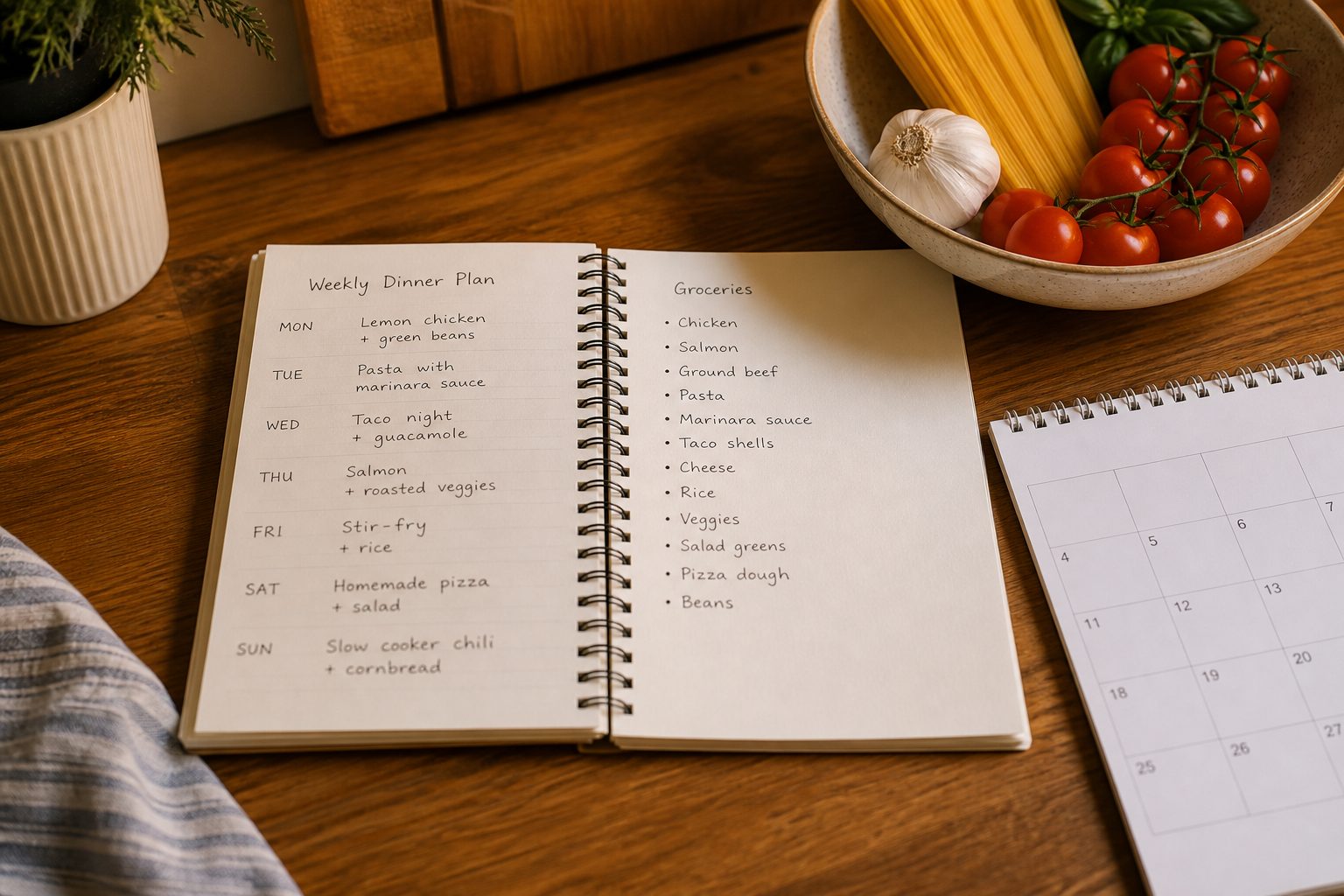
This is part of why a weekly view works better than planning meal by meal as the week unfolds. Seeing five or six dinners laid out together makes it obvious, at a glance, which nights are heavier and which are lighter, and it makes swapping two nights a two-second decision instead of a fresh one made under pressure at five o'clock. A recipe saved once can sit on that calendar and get reused across different weeks without anyone rebuilding it from scratch each time.
The fixed-versus-flexible question also shows up in how a plan handles the unexpected. A rigid plan treats an unplanned dinner invitation or a night of leftovers as an exception that breaks the system, something to feel behind on. A flexible-but-structured plan treats the same event as simply removing one item from an otherwise intact week — nothing else has to move, nothing has to be redone, and the rest of the week's dinners are still exactly where they were. The difference isn't in how often disruptions happen, since they happen to everyone at roughly the same rate. It's in whether the plan was built to absorb them.
What Simplifying Without Rigid Perfection Actually Looks Like
Put together, easy dinner planning looks less like a strict system and more like a loose scaffold that holds most of the week's shape without demanding all of it. A handful of meals get decided in advance — enough to build a shopping list and know the week has a direction — while a night or two stays open on purpose, for leftovers, for a change of mind, for whatever the fridge happens to suggest by Thursday.
This kind of plan doesn't require getting every meal exactly right, and it shouldn't be graded on how closely the week ends up matching what was written down. A Tuesday that becomes a Wednesday, or a planned dinner that gets skipped in favor of something simpler, isn't a failure of the plan. It's the plan doing its job, since the entire point was to remove pressure from the moment of deciding, not to lock the week into place.
It also helps to let the plan be genuinely imperfect at the edges. Not every dinner needs a full recipe behind it — some nights can simply say "pasta with whatever vegetables are left" without anyone needing to nail down exact quantities in advance. Leaving a night or two loosely defined, on purpose, keeps the plan from feeling like a checklist that has to be satisfied precisely. It's still a plan, in the sense that there's an intention for that night rather than a blank space, but it doesn't pretend to know more about that day than anyone reasonably can a week ahead of time.
What makes this sustainable, more than any single trick, is having a place the plan actually lives — somewhere it's visible before the week starts, rather than reconstructed from memory every evening. A calendar that shows the whole week's dinners together, built from recipes that are already saved rather than reinvented, turns "easy" from a vague hope into something closer to a habit. myDinnerPlan is built around exactly that kind of weekly calendar, free to start, so the shape of a week is something you can actually see rather than something you're holding in your head.
If any of this sounds like the kind of loose, forgiving structure worth trying for a week, you can set up a free account and lay out a handful of dinners to see how much lighter the week feels with a default already in place. Easy, in the end, isn't about doing less. It's about deciding less often, and giving yourself permission to let the plan bend when the week does.
Ready to put this into practice? Plan your week with myDinnerPlan.
Create free account