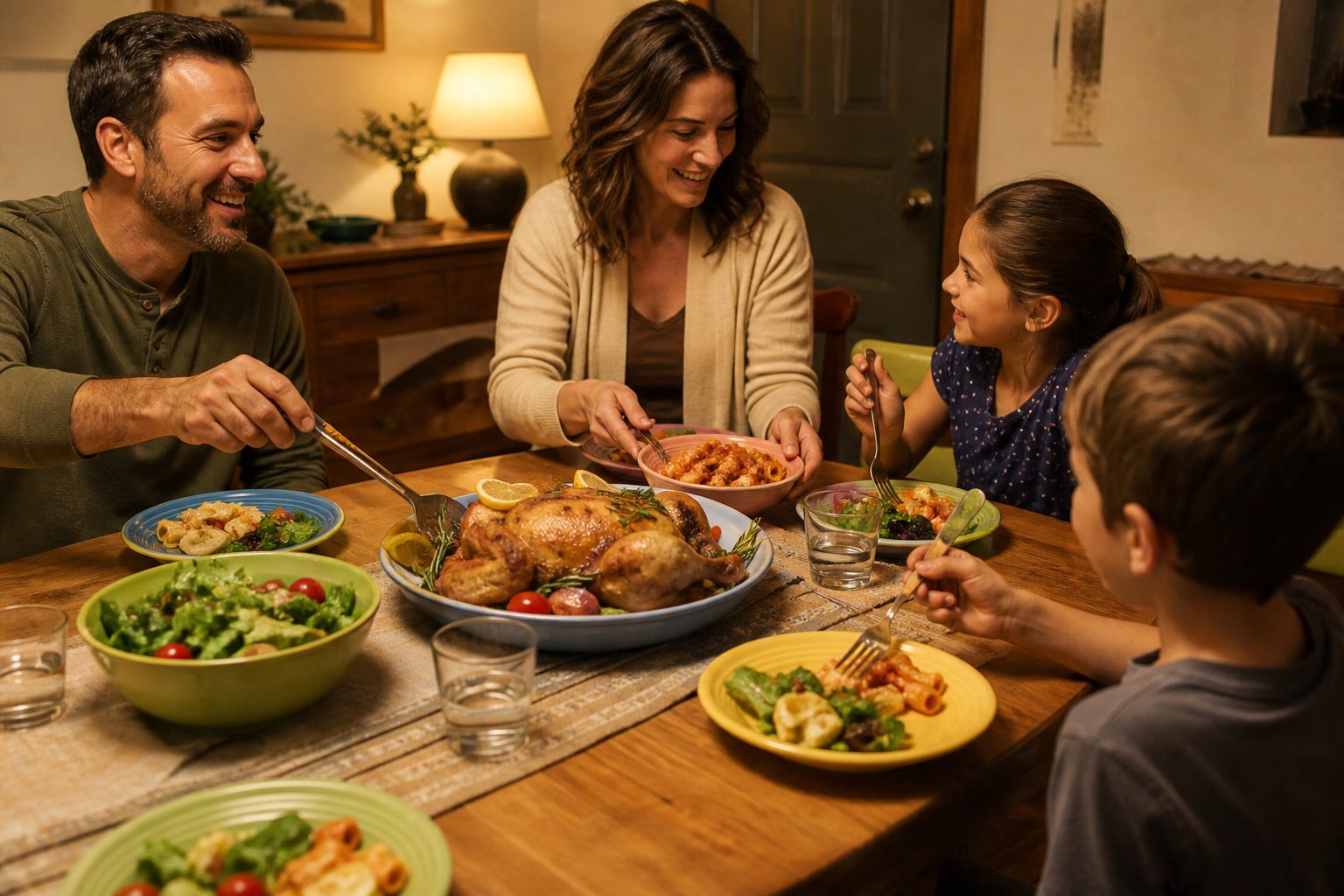
"Family-friendly" gets used as shorthand for a fairly narrow idea: beige food, mild flavors, and a short list of dishes that a picky eight-year-old will eat without negotiation. That's a real category, and there's nothing wrong with a house that leans on it. But it's a much smaller idea than the phrase implies, and treating it as the whole definition tends to box a household into the same six dinners indefinitely, long after the kids who needed the blandest version of dinner have grown into people with actual opinions about food. It's worth pulling the phrase apart a little and looking at what it's actually being asked to do.
"Kid-Approved" vs. Actually Family-Friendly
Kid-approved usually means one thing: a specific child, at a specific age, will eat it without a fight. That's a useful data point, but it's not the same as a meal working for the household as a whole, which usually includes at least one adult who'd like something with more than three ingredients, possibly another kid with completely different tastes, and sometimes a grandparent or partner with their own preferences layered on top. A genuinely family-friendly dinner is one that everyone at the table can eat something off of, not necessarily the identical plate.
That distinction matters because chasing kid-approval alone tends to narrow the rotation over time rather than widen it. Once a dish is confirmed to work, there's a strong pull to keep making it exactly the same way indefinitely, because deviation risks the one thing that was reliably working. The result, a few years in, can be a family that's technically eating fine but has quietly stopped trying anything new, not because anyone decided that on purpose but because nobody wanted to be the one who broke a streak of easy dinners.
There's also a version of family-friendly that has nothing to do with kids at all: a grandparent who eats less spice than they used to, a partner managing a health condition, a teenager who's decided to eat less meat. A household's food needs to flex in more directions than just toward the youngest person at the table, and a plan built entirely around one child's preferences from a few years ago tends to age poorly as everyone else's needs shift too. Thinking of "family-friendly" as covering everyone currently sitting down to eat, rather than as a permanent label attached to a handful of dishes, keeps the definition useful instead of stuck.
One Shared Meal vs. Two Separate Dinners
There's a real tradeoff between cooking one meal that mostly works for everyone and cooking two, a simplified version for kids and a different one for adults. Two separate dinners solve the immediate problem: everyone eats something they like tonight. But it doubles the cooking and the cleanup, and it quietly teaches kids that the "adult" version of dinner is a different, more interesting category of food they'll eventually graduate into, rather than something they're already part of.
The alternative isn't forcing one identical plate on a four-year-old and a forty-year-old. It's building meals with a shared core, the same protein, the same base grain or vegetable, and letting seasoning, spice level, or a specific topping vary at the table. A curry can be milder on one side of the pot and finished with more chili on the other. A taco night lets everyone build their own plate from the same ingredients. This isn't always possible, some dishes really don't flex that way, and on those nights a genuinely separate kids' meal is a reasonable call rather than a failure. But when a shared-core approach can work, it tends to hold up better over months than either extreme, because it doesn't require constant improvisation and it doesn't quietly split the table into two food cultures.
The cost of the two-dinner approach is easy to underestimate because it doesn't show up all at once. Any single night of cooking a separate kids' plate alongside the adult dinner is manageable. It's the accumulation, weeks and then years of two parallel dinners every night, that turns into a genuinely heavy load, and it's one that usually falls unevenly on whoever's doing most of the cooking. Shared-core meals aren't a moral improvement over separate plates, but they are, most of the time, meaningfully less work to sustain over the long run, which is worth weighing honestly against how much a given household actually values total customization on a given night.
A New Recipe vs. A Working Rotation
New recipes get most of the attention in food media, and there's a place for trying something none of you have had before. But a rotation, the same eight or twelve dinners cycling with some intention, does more of the actual work of feeding a family well over time. It's lower risk on a weeknight, it's what lets a shopping list stay predictable, and it's what actually gets cooked when the day has gone sideways and there's no energy left for a recipe nobody's made before.
The comparison isn't really "new versus repeated," because a healthy rotation isn't static either. It changes a few times a year as kids' tastes shift and as a household finds new dishes worth keeping. The difference is pace: a rotation absorbs one or two new dishes at a time, tests them under normal weeknight conditions, and either keeps them or lets them go, rather than treating every dinner as an experiment. Saving the dishes that survive that test, so they're easy to find again instead of half-remembered, is what actually builds a rotation worth having, as opposed to a growing pile of recipes bookmarked and never made twice.
Winning Tonight vs. Earning Trust Over Time
A single dinner that gets refused isn't evidence that a food or a whole approach has failed. Kids' willingness to try things shifts over weeks and months, often for reasons that have little to do with the dish itself, tiredness, a day at school, a texture that felt different than expected. Judging a broader shift toward more variety by whether tonight's plate got eaten is judging it on the wrong timescale.
A more useful measure is whether, over a month or two, the range of things a kid will put in their mouth has widened even slightly, and whether family meals still feel manageable to cook in the meantime. That means tolerating some short-term refusal without treating it as a crisis, and it means not overhauling the whole rotation every time one new dish gets pushed to the side of the plate. Small, repeated, low-pressure exposure tends to do more over time than any single dinner, win or lose.
This is also where a rotation and a longer view work together rather than against each other. A dish that gets refused the first time it appears isn't necessarily gone for good, it can simply come back in a month, prepared the same way or slightly differently, without any announcement or pressure attached to it. Kids' relationship to a given food often shifts on its own timeline, and reintroducing something quietly, as just another night on the rotation rather than a retry that's being watched closely, tends to get a fairer second chance than a dish that's clearly being reintroduced as a test.
Picky Eating vs. Just a Preference
Not every food a kid won't eat is "picky eating" in the sense that gets talked about with real concern. Plenty of it is ordinary preference, the same kind adults have, just expressed with less diplomacy. An adult who avoids mushrooms isn't described as a picky eater; a kid who does the same thing often is. Separating genuine, persistent, anxiety-driven food refusal from a seven-year-old who just doesn't like a particular texture matters, because the two call for very different responses, and treating ordinary preference as a problem to solve tends to make mealtimes tenser than the underlying issue warrants.
For most families, most of the time, the practical answer looks the same either way: keep at least one familiar, reliably eaten item on the table alongside whatever else is being served, so nobody's dinner depends entirely on a food they're unsure about. That's not a workaround or a lesser version of family-friendly cooking, it's close to how a lot of adults eat too, gravitating toward something known alongside something less certain.
Where the two do diverge is in how much a parent should read into any single refusal. Ordinary preference tends to be flexible over time and responsive to how a food is prepared, served, or presented, a raw vegetable refused today might be eaten roasted next month. More persistent, anxiety-driven refusal usually doesn't move the same way regardless of preparation, and pushing harder on it tends to entrench it rather than resolve it. Neither situation is solved by a better rotation or a cleverer recipe, but knowing roughly which one is in front of you changes whether the right move is patience and repeated low-key exposure or a different kind of support altogether.
None of this requires an elaborate system, just a way to see the week's dinners together and notice which ones are actually carrying the rotation versus which ones showed up once and never came back. A shared weekly dinner calendar that the whole household can see, with recipes saved so they're easy to reuse instead of rebuilt from memory, is the basic shape myDinnerPlan is built around, along with a shopping list pulled from whatever's on the calendar. It's free to start, and there's no pressure to redesign how your family eats overnight. If it's useful, you can set one up here and see how a slightly wider rotation feels over a few weeks.
Ready to put this into practice? Plan your week with myDinnerPlan.
Create free account