Why Involving Kids Helps and Where It Backfires
Ask a room full of parents whether kids should have a say in dinner, and you will get two answers delivered with equal conviction. One camp says yes, absolutely, because a kid who picked the meal is more likely to eat it without a fight. The other camp says no, absolutely not, because the last time they tried it, dinner planning turned into a floor negotiation over chicken nuggets versus a food none of the adults had ever heard of. Both are right, which is the actual problem. Involving kids in meal planning works, but only within limits that most families never set on purpose — they just discover the limits by accident, usually during a rough Tuesday.
The upside is real and worth taking seriously rather than dismissing as a nice-to-have. A child who chose a recipe, even loosely, tends to approach it with more curiosity than one who was simply told what was on the plate. That is not because the food itself changed, but because the decision changed hands, even briefly, and having some say in a small thing tends to make people — kids very much included — more willing to go along with the rest of it. The downside is just as real: an open-ended question like "what do you want for dinner" handed to a seven-year-old is not really a planning tool, it is an invitation to negotiate, and small kids negotiate the way small kids negotiate, which is to say without much regard for the pantry, the calendar, or what their sibling already vetoed. The fix is not to remove kids from the process. It is to give them a role narrow enough that it cannot expand into an argument.
Age-Appropriate Roles That Actually Hold Up
The right role for a four-year-old and the right role for a ten-year-old are not the same, and treating them the same is usually where things go wrong. A younger child does well with a choice between two things that are both already acceptable to the adults — this vegetable or that one, this shape of pasta or the other one sitting in the pantry. The choice is real, in that either answer is fine and will actually be honored, but it is bounded tightly enough that there is no path to an argument. The child gets to decide something; the adults have already decided what the something is allowed to be.
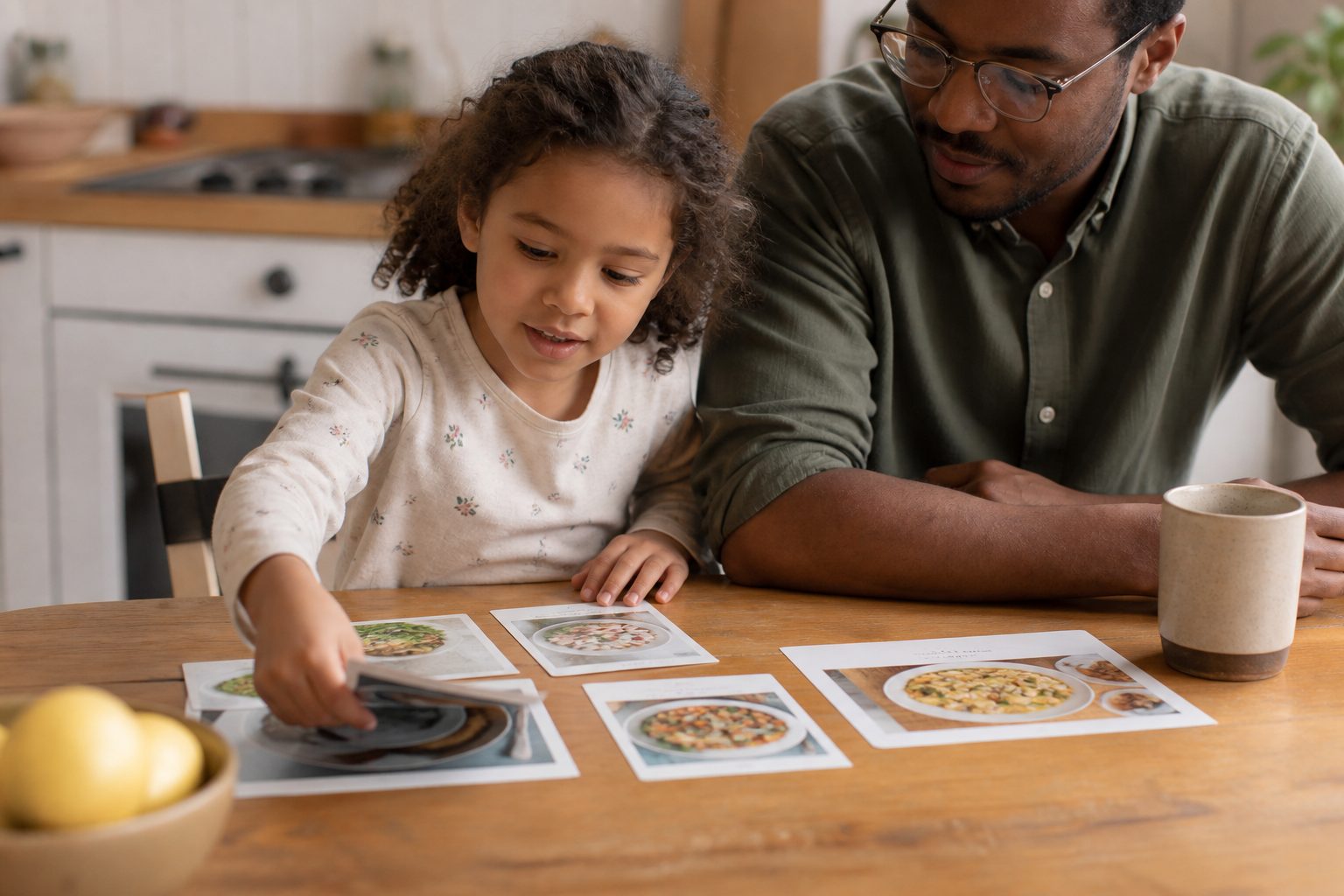
An older child, roughly school age and up, can handle more. Picking one full dinner for the week from a short list of recipes the family already likes is a reasonable ask, especially if the list is visual rather than verbal — a handful of saved recipes they can actually look at rather than try to recall from memory. Older kids and early teenagers can go further still: choosing a new recipe to try, within some loose guardrails about ingredients or effort, and in some households, actually being the one who cooks it with supervision. Each of these roles has a boundary built in — a set number of choices, a defined slot on the calendar, a short list rather than an open question — and the boundary is what keeps the role from turning into an argument rather than a contribution. Without a boundary, even a good-faith attempt to include a kid tends to drift into an unstructured back-and-forth that ends with someone frustrated and dinner no closer to being decided.
It also helps to separate the role from the responsibility for the whole week. A kid picking one dinner out of seven is participating in the plan, not running it. The adults are still holding the shape of the week — what nights are busy, what needs to use up something already in the fridge, what has to be quick — and the kid's choice slots into that shape rather than overriding it. That distinction matters more than it sounds like it should, because a lot of the friction around involving kids comes from accidentally handing over more control than intended and then having to walk it back mid-argument.
Keeping a Small Number of Things Non-Negotiable
Every family ends up with a short list of things that are not actually up for a vote, whether or not they say so out loud. Maybe it's that vegetables show up most nights regardless of who picked the meal. Maybe it's that a new recipe only gets tried on a night when there is a reasonable backup if it flops. Making that short list explicit, even just to the adults involved in planning, does more good than it seems like it should. It means a kid's choice is never actually a choice about whether the non-negotiable thing happens — only about which acceptable option fills the negotiable part. That framing avoids a whole category of arguments, because the child was never actually being asked to override the vegetable, the shared meal, or the family's habit of trying something new once a week; they were only ever choosing within a space the adults had already fenced off.
This is also where repetition earns its keep. A recipe that has been made before, that a kid already knows they like, is a much safer thing to hand over as a choice than an entirely open slot. If the choice is "which of these four dinners we've made before do you want this week," the range of possible outcomes is narrow enough that every answer is fine. If the choice is "what do you want to eat," the range is unbounded, and unbounded choices are exactly the ones that turn into a longer conversation than anyone had time for. Keeping a rotating set of recipes that kids already recognize gives them something concrete to choose from, rather than asking them to invent a preference out of nothing.
Handling Pushback Without Cooking Twice
Even with roles and boundaries in place, pushback happens, because kids are people and people do not always like the outcome of a process they participated in. The instinct in the moment is often to offer an alternative — a different plate, something else made quickly — and that instinct, while understandable, tends to teach a lesson opposite to the one intended. It suggests that enough resistance produces a second meal, which makes every future night a little more negotiable than the last.
A steadier approach treats the plan as already settled once it is on the calendar, with the flexibility built in earlier rather than offered as a concession later. That might mean the vegetable is always something at least one person at the table already likes, so refusal is about preference rather than genuine dislike. It might mean a standing side that requires no cooking — bread, fruit, something simple — sits on the table most nights as a safety net that does not require anyone to prepare a second dinner. Neither of these is a workaround invented in the moment; both work because they were decided ahead of time, during planning, rather than negotiated at the table under pressure. The difference between a plan that holds and one that unravels most nights usually comes down to how much was decided in advance versus how much is being decided, again, in the middle of dinner.
Loosening the Reins as Kids Get Older
The roles that work for a six-year-old will feel restrictive to the same child at eleven, and part of keeping this whole approach sustainable is revisiting it periodically rather than assuming today's boundaries fit forever. A child who has spent a couple of years choosing between two acceptable sides is probably ready to pick a full dinner from a slightly longer list. One who has been choosing dinners for a while might be ready to help build the shopping list for what they picked, or even take a real hand in cooking part of it. The goal, over time, is not to keep kids permanently within a narrow set of choices, but to widen the boundary gradually as they show they can handle it — which mostly means watching whether their choices still fit into the week without creating extra work, rather than assuming either way.
None of this requires a formal system, but having the week's options somewhere visible — recipes actually saved and laid out rather than described from memory — makes the whole thing easier to hand over in small pieces. myDinnerPlan keeps saved recipes and the weekly calendar in one place that a household can look at together, which makes it simpler to hand a child an actual short list to choose from instead of trying to describe four dinners out loud. It is free to start, and for families who want kids picking from a real weekly view rather than a verbal list, creating an account is a low-effort way to see whether that structure helps.
Meal planning with kids in the room is not about getting them to agree with the adults' choices more often, and it is not about surrendering the plan to a committee where everyone under twelve has equal say. It is about finding the narrow, age-appropriate slice of the decision that genuinely belongs to them, holding the rest steady, and adjusting the size of that slice as they grow into being able to handle more of it.
Ready to put this into practice? Plan your week with myDinnerPlan.
Create free account